Additional information
| Type of knife | fish knife, hand-forged knife, Kasumi knife, professional knife, sushi knife, Takobiki |
|---|---|
| Blade length (mm) | |
| Total length (mm) | |
| Knife weight (g) | |
| Steel type | |
| Rockwell hardness of steel | |
| Stain-resistant | |
| Handle |
* does not apply to cash on delivery shipments
3,500.00 zł brutto
In stock
| Type of knife | fish knife, hand-forged knife, Kasumi knife, professional knife, sushi knife, Takobiki |
|---|---|
| Blade length (mm) | |
| Total length (mm) | |
| Knife weight (g) | |
| Steel type | |
| Rockwell hardness of steel | |
| Stain-resistant | |
| Handle |
You must be logged in to post a review.
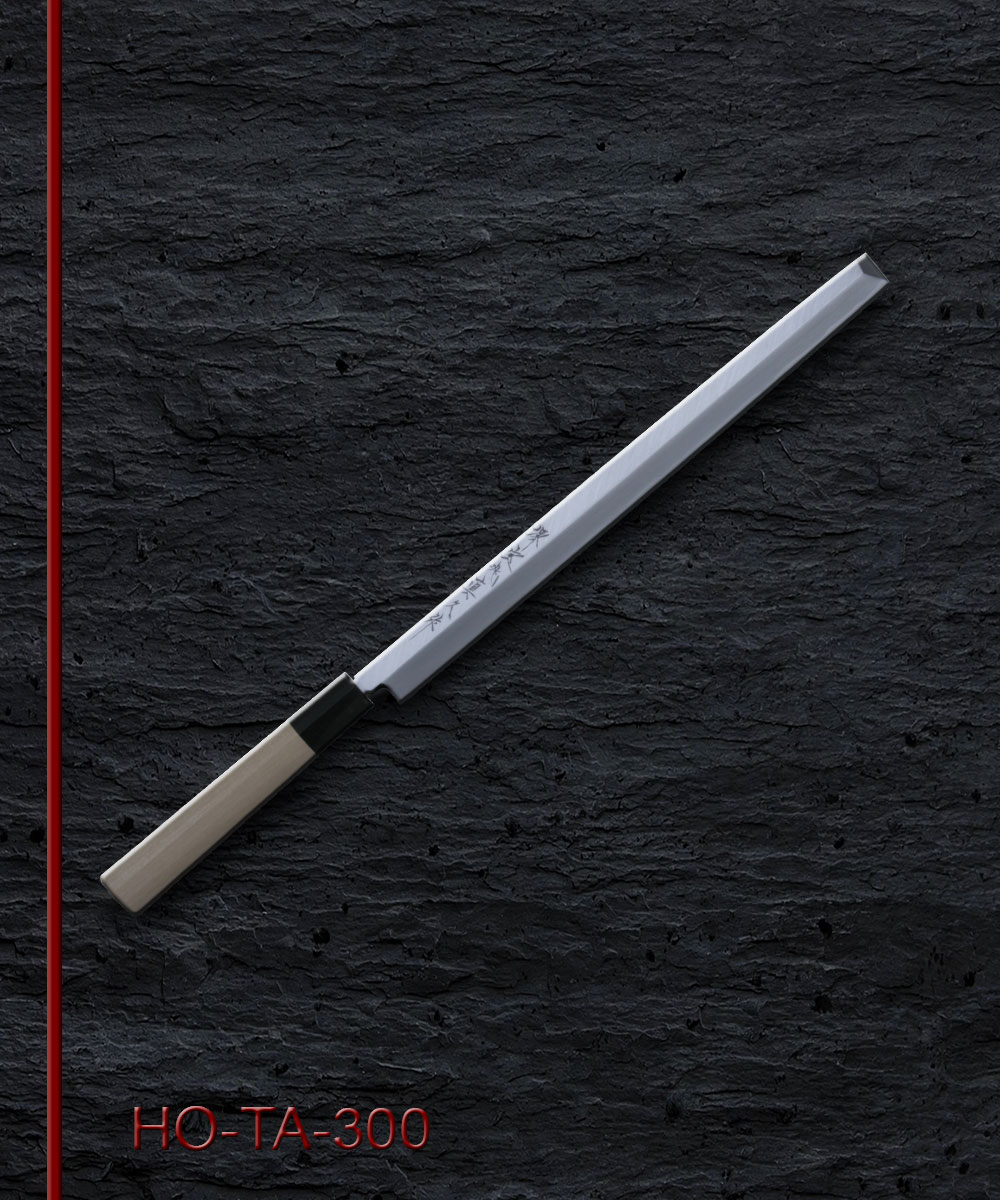
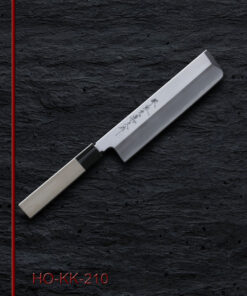
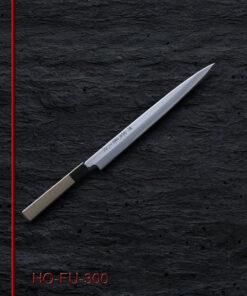
HO-TA-300 from the HO Takobiki (タコ引) series is a knife created without compromise. It is a blade rooted directly in the elite tradition of the Tokyo sushi school, designed for chefs who understand that precision is a form of respect for the ingredient—and that the tool is an extension of the master’s hand.
Takobiki is a long, slender knife with a distinctive rectangular tip, single-bevelled to a kataba edge. This shape is no accident. It originated in the Kanto region (Tokyo), where—according to tradition—using a Yanagiba, whose silhouette resembles a sword, was considered inappropriate when preparing sashimi in front of guests. Takobiki emerged as the answer to a need for elegance, restraint, and absolute control.
The square tip allows not only exceptionally clean, long cuts, but also delicate lifting and transferring of thin fish slices from board to plate without damaging their structure. This is a detail that separates true craftsmanship from routine—which is why the most traditional and exclusive restaurants in Tokyo still choose Takobiki over Yanagiba.
In the HO version, this classic profile is elevated to a collector’s level. The blade, forged using the Kasumi technique with a core of high-carbon YASUKI White 2 steel, delivers extreme sharpness, purity of cut, and the ability to achieve an almost mirror-like slicing surface. Every movement of the blade is a single, uninterrupted stroke—exactly as demanded by the highest school of sushi.
The 300 mm length provides full control over long cuts “from heel to tip,” without tearing, pressure, or compromise. The straight finish, perfect balance, and thin blade make slicing octopus, tuna, or white fish feel almost ritualistic—calm, precise, and fully intentional.
It is no coincidence that the ability to use a Takobiki is considered a hallmark of a true sushi master. This blade does not forgive mistakes, but in return it offers something far more valuable: total control, aesthetics, and prestige that cannot be imitated.
HO-TA-300 is not a knife “for the kitchen.”
It is a tool of status, a choice for those who know that true mastery begins with a perfect cut.
If you want to consciously build your knife set and understand the differences between styles and traditions, take a look at our guide.
Jjamppong originated in Korean port cities as a dish inspired by Chinese immigrants, mainly from the Shandong region. Over time, Koreans gave it their own identity: bold heat, deep seafood flavor, and a hearty noodle base. Today it’s one of the most iconic examples of Korean comfort food – fiery, aromatic, and unapologetically intense. This is a soup meant to warm you up, fill you up, and wake up your senses.
Homemade egg noodles
2 cups all-purpose flour
3 large eggs
½ teaspoon kosher salt
2 tablespoons water
1 tablespoon vegetable oil
Jjamppong soup
1 tablespoon vegetable oil
½ large onion, finely chopped
3 cloves garlic, finely minced
1 teaspoon fresh ginger, finely grated
1–3 tablespoons Korean chili flakes (gochugaru), to taste
2 cups squid, thawed
18 fresh clams
3 cups mixed seafood (shrimp, mussels, etc.), thawed
6 leaves Napa cabbage, roughly chopped
½ large zucchini, sliced into half-moons
5 cups chicken stock
1 bunch spinach, roughly chopped
about 8 oz (225 g) cremini mushrooms, chopped
18 fresh shrimp, peeled and deveined, tails removed
1 teaspoon spicy Asian chili oil
½ tablespoon sesame oil
salt and freshly ground black pepper
about 1 lb (450 g) fresh noodles
⅓ cup green onions, finely sliced
Noodles
Add flour and salt to the bowl of a stand mixer. Make a well in the center and add the eggs and water. Mix on low speed for 1–2 minutes, until the dough begins to come together.
Switch to the dough hook and knead for 2–3 minutes on speed 2, until smooth and elastic.
Transfer the dough to a work surface and knead by hand for 3–4 minutes. Form into a ball, wrap in plastic wrap, and rest for 20–30 minutes.
Divide the dough into 4 portions. Roll each piece through a pasta machine, starting on the widest setting and folding several times, then gradually moving to thinner settings until smooth sheets form.
Cut using a fettuccine attachment, lightly dust with flour, and shape into nests. Extra noodles can be refrigerated, frozen, or air-dried.
Soup
Heat vegetable oil in a large heavy-bottomed pot over medium heat. Add onion, garlic, and ginger. Sauté for a few minutes until softened and fragrant.
Stir in 1 tablespoon of gochugaru and mix well to bloom the chili. Add squid, clams, mixed seafood, cabbage, and zucchini. Stir-fry for 3–4 minutes.
Pour in the chicken stock and bring to a rolling boil. Add mushrooms and spinach and cook for 4–5 minutes. Add shrimp, chili oil, sesame oil, and more gochugaru to reach your desired heat level. Season with salt and pepper.
Add fresh noodles and green onions. Cook for 4–5 minutes, until the noodles are al dente. Stir well and serve immediately.
Jjamppong is best enjoyed piping hot – spicy, briny, deeply savory, and intensely satisfying. This is a soup with no compromises.

In stock

In stock

In stock

In stock

In stock

In stock

In stock

In stock

Check availability.
sklep@macknives.pl
+48 733 804 975
Zdjęcia ilustrujące przepisy na stronach produktowych wykorzystano z serwisów: photo-ac.com, freepik.com i pixabay.com na podstawie licencji udzielanych przez owe serwisy.
Reviews
There are no reviews yet.