Additional information
| Type of knife | hand-forged knife, Kasumi knife, professional knife, sushi knife |
|---|---|
| Total length (mm) | |
| Knife weight (g) | |
| Steel type | |
| Rockwell hardness of steel | |
| Stain-resistant | |
| Handle |
* does not apply to cash on delivery shipments
2,520.00 zł brutto
In stock
| Type of knife | hand-forged knife, Kasumi knife, professional knife, sushi knife |
|---|---|
| Total length (mm) | |
| Knife weight (g) | |
| Steel type | |
| Rockwell hardness of steel | |
| Stain-resistant | |
| Handle |
You must be logged in to post a review.
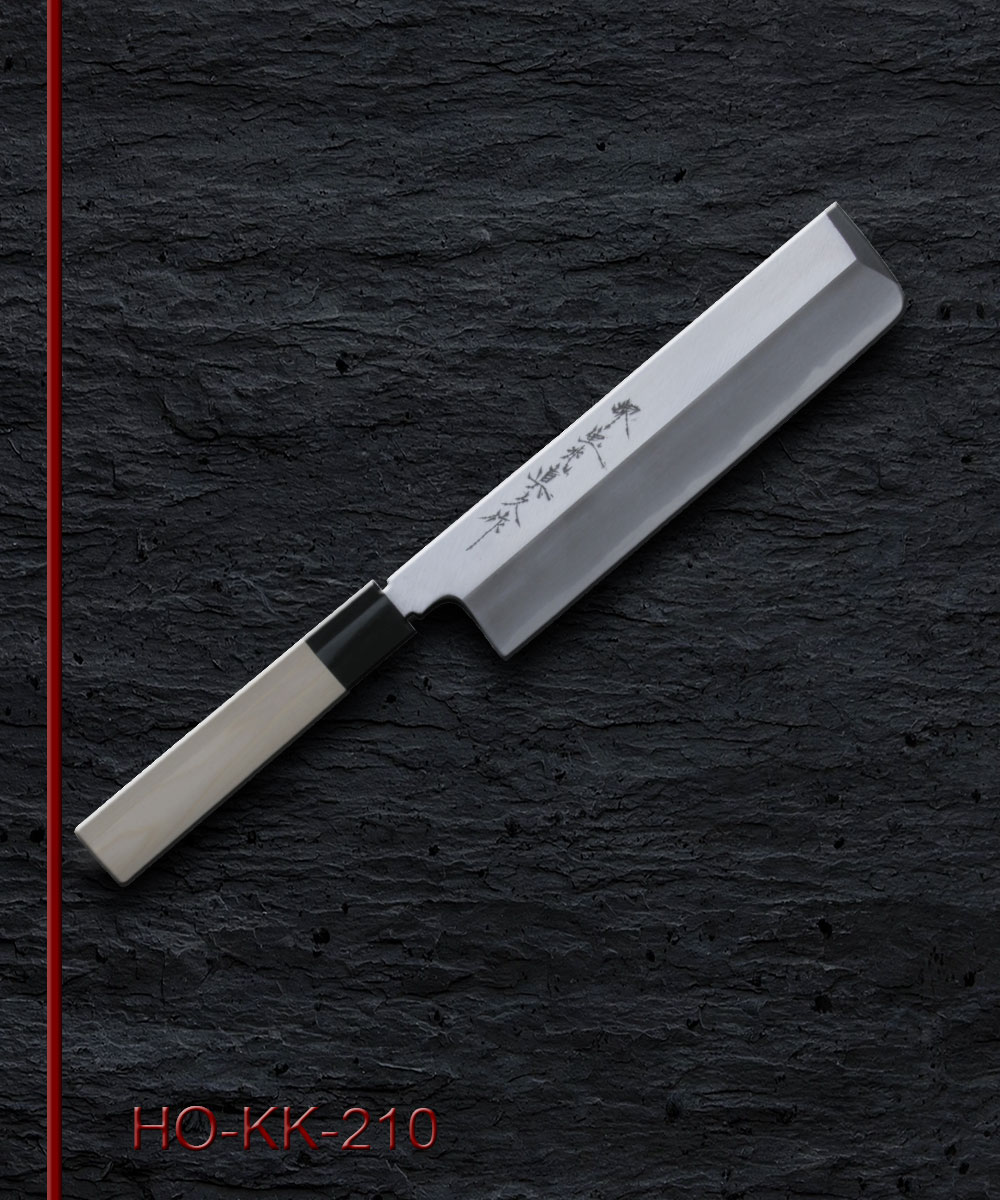
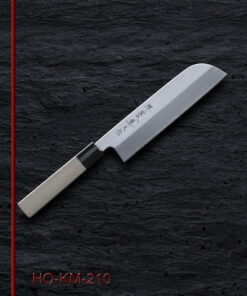
HO-KK-210 from the prestigious HO Kasumi series is the essence of Japanese precision and culinary aesthetics captured in the classic, square Kakugata Usuba (角形うすば) form. This knife was created for masterful preparation of vegetables and fruits served raw—where absolute control, purity of the cut, and preservation of the ingredient’s structure are paramount.
The thin, hand-forged blade made using the Kasumi technique combines a core of high-carbon YASUKI White 2 steel with a protective layer of soft low-carbon steel. This construction delivers extreme sharpness and easy sharpening while protecting the blade from excessive brittleness. The result is a cutting surface with virtually no cellular damage, minimal oxidation, no discoloration, and full preservation of the natural flavor and texture of vegetables.
Kakugata Usuba is the classic choice of professional Japanese chefs, especially in the Kanto (Tokyo) region. The straight, square tip allows for perfectly linear cuts, precise portioning, and advanced techniques such as Katsuramuki—rotational peeling that creates ultra-thin, almost translucent vegetable sheets. The tall, long blade handles large ingredients like cabbage or daikon with ease, while offering full control thanks to the ability to guide the blade using the knuckles of the free hand.
As befits the HO series, the knife is fitted with a traditional, oval handle made from magnolia wood, reinforced with buffalo horn. Perfect balance, natural materials, and exceptional ergonomics make the HO-KK-210 an extension of the chef’s hand—allowing focused, fatigue-free work even during long preparation sessions.
This is not a universal knife. It is a knife of conscious choice—for those who understand that in Japanese cuisine vegetables deserve the same respect as fish in sushi. The HO-KK-210 is not intended for hard vegetables or fruits with pits; its purpose is perfection, not compromise.
The HO Kasumi series is a symbol of status, craftsmanship, and culinary maturity. Each knife is handcrafted in Sakai—a city that has set the standard for Japanese knife making for centuries. Owning a Kakugata Usuba from this series is not only a functional decision, but also a collector’s one.
HO-KK-210 is a tool for those who do not ask whether they need such a knife—they know that without it, a kitchen is simply incomplete.
Yosenabe is one of the most versatile and communal Japanese hot pot dishes. There is no single “correct” ingredient list — seasonality, freshness, and the joy of cooking together at the table are what matter most. A fragrant dashi broth, delicate meats, seafood, and vegetables cooked in stages create a dish that celebrates calm, conversation, and pure flavor.
Meat
– tender chicken (breast or thigh, boneless)
– optionally other meats of your choice
Seafood
– sablefish
– shrimp
– Manila clams
– alternatively: scallops, mussels
Vegetables
– napa cabbage
– chrysanthemum leaves (shungiku)
– carrot (sliced or cut into ribbons)
– negi (Japanese long onion)
Mushrooms
– shiitake
– shimeji
– enoki
Tofu
– medium-firm tofu, cut into cubes
Broth
– awase dashi (kombu + katsuobushi)
Seasonings
– sake
– mirin
– soy sauce
– salt (to adjust seasoning)
To finish
– finely sliced green onion
– yuzu zest
– shichimi togarashi
Step 1: Set the table
Place a portable burner and a nabe pot in the center of the table. Make sure everyone can easily reach it — for larger groups, consider using two pots.
Arrange the ingredients on platters around the pot, grouped by type (meat, seafood, vegetables, mushrooms).
Step 2: Heat the broth
Pour the awase dashi into the pot and bring it to a gentle boil.
If using root vegetables (such as daikon, gobo, or thick carrot slices), add them at this stage as they require longer cooking.
Step 3: Cook in stages — no rushing
Once the broth is simmering, add ingredients in small batches, arranging them in sections:
– napa cabbage in one area
– mushrooms in another
– seafood separately
Do not overcrowd the pot.
Yosenabe is a process — cook, serve, eat, and enjoy the moment. Cover and simmer for 8–10 minutes.
Remember: leafy vegetables and seafood cook much faster than chicken.
Step 4: Serving
Lift the cooked ingredients from the pot and serve immediately — it’s a thoughtful gesture to help those seated nearby.
Yosenabe does not require dipping sauces — the broth carries all the flavor.
Finish with green onion, yuzu zest, and/or shichimi togarashi.
Step 5: Continue with new rounds
Once the pot is mostly empty, add another batch of ingredients.
Top up with water or dashi if needed.
Repeat for 2–3 rounds until all ingredients are used.
At the very end, when the broth is deeply flavorful, add cooked rice or udon noodles — this traditional finale is known as shime.
Warm, calming, and perfect for long evenings together.

In stock

In stock

In stock

In stock

In stock

In stock

In stock

In stock

Check availability.
sklep@macknives.pl
+48 733 804 975
Zdjęcia ilustrujące przepisy na stronach produktowych wykorzystano z serwisów: photo-ac.com, freepik.com i pixabay.com na podstawie licencji udzielanych przez owe serwisy.
Podaj swoje imię i nazwisko, numer telefonu oraz godziny w jakich możemy skontaktować się z Tobą.
Oddzwaniamy tylko pod numery telefonu z polskim numerem kierunkowym +48.
Reviews
There are no reviews yet.