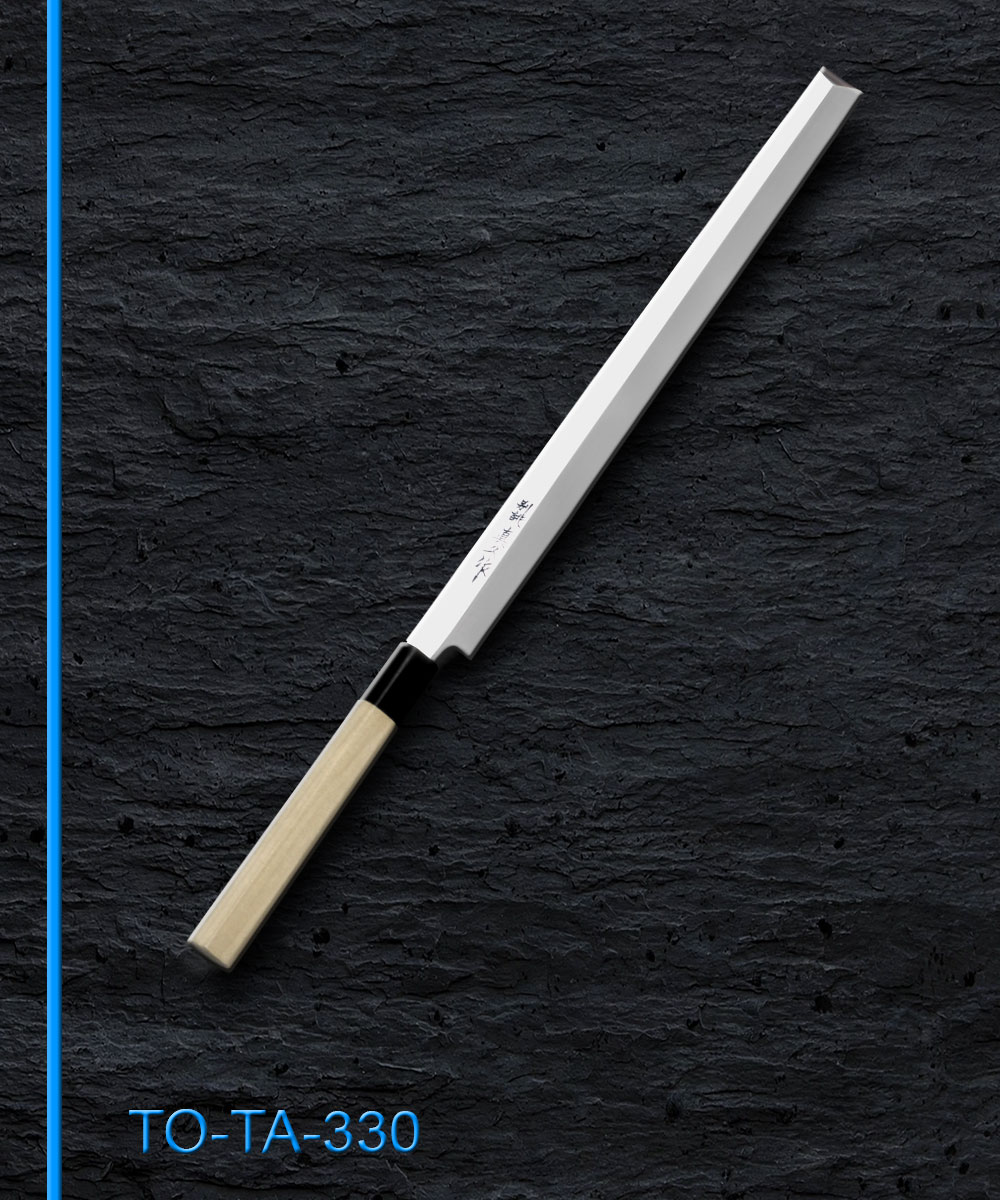
TO-TA-300 Takobiki – Tokyo craftsmanship in its purest form
The TO-TA-300 from the prestigious TO Honoyaki series is not an ordinary Japanese kitchen knife. It is a manifesto of the highest level of craftsmanship—an instrument reserved for those who understand that true luxury in the kitchen does not shout; it is silent and cuts with absolute perfection. This traditional Japanese Takobiki (Tako-hiki / タコ引) knife was born in the Kanto region (Tokyo) and for generations has remained a symbol of the elite Tokyo school of sushi masters.
The distinctive square tip, long and slender blade, and single-bevel kataba grind are no coincidence. Takobiki was designed for maximum control, refined aesthetics, and uncompromising cutting precision—especially when working with octopus, raw fish, and sashimi sliced into ultra-thin, almost translucent pieces. The thin blade glides more quietly, smoothly, and effortlessly than a classic Yanagiba, delivering results that in Tokyo are regarded as the benchmark of the highest class.
The Honoyaki series represents the pinnacle of Japanese knife forging. Each TO-TA-300 is the work of a master craftsman, forged through a process that demands years of experience, precise temperature control, and total concentration. These knives are made individually—without compromises, without automation, without mass production. This is precisely why Honoyaki knives are coveted by collectors, professional sushi masters, and top-tier chefs worldwide.
Historical accounts suggest that in old Edo (modern-day Tokyo), using a Yanagiba—whose shape resembles a sword—while slicing sashimi in front of guests was considered improper. Takobiki emerged as an answer to the need for subtlety, culture, and respect. To this day, the most exclusive restaurants in Tokyo choose Takobiki as a symbol of class, calm mastery, and complete control over the ingredient.
The square blade tip not only enables flawless cutting but also allows for the elegant transfer of fish slices from board to plate without disturbing their structure—a detail appreciated by anyone who understands the aesthetics of Japanese cuisine. Mastery of the Takobiki knife is no accident; it is a hallmark of a true master, proof of knowledge, experience, and respect for tradition.
The TO-TA-300 is a choice for those who do not ask, “Do I need this knife?” but know that some things are simply meant to be owned.
It is a professional tool, a collector’s piece, and a symbol of status—combined into one.





Reviews
There are no reviews yet.