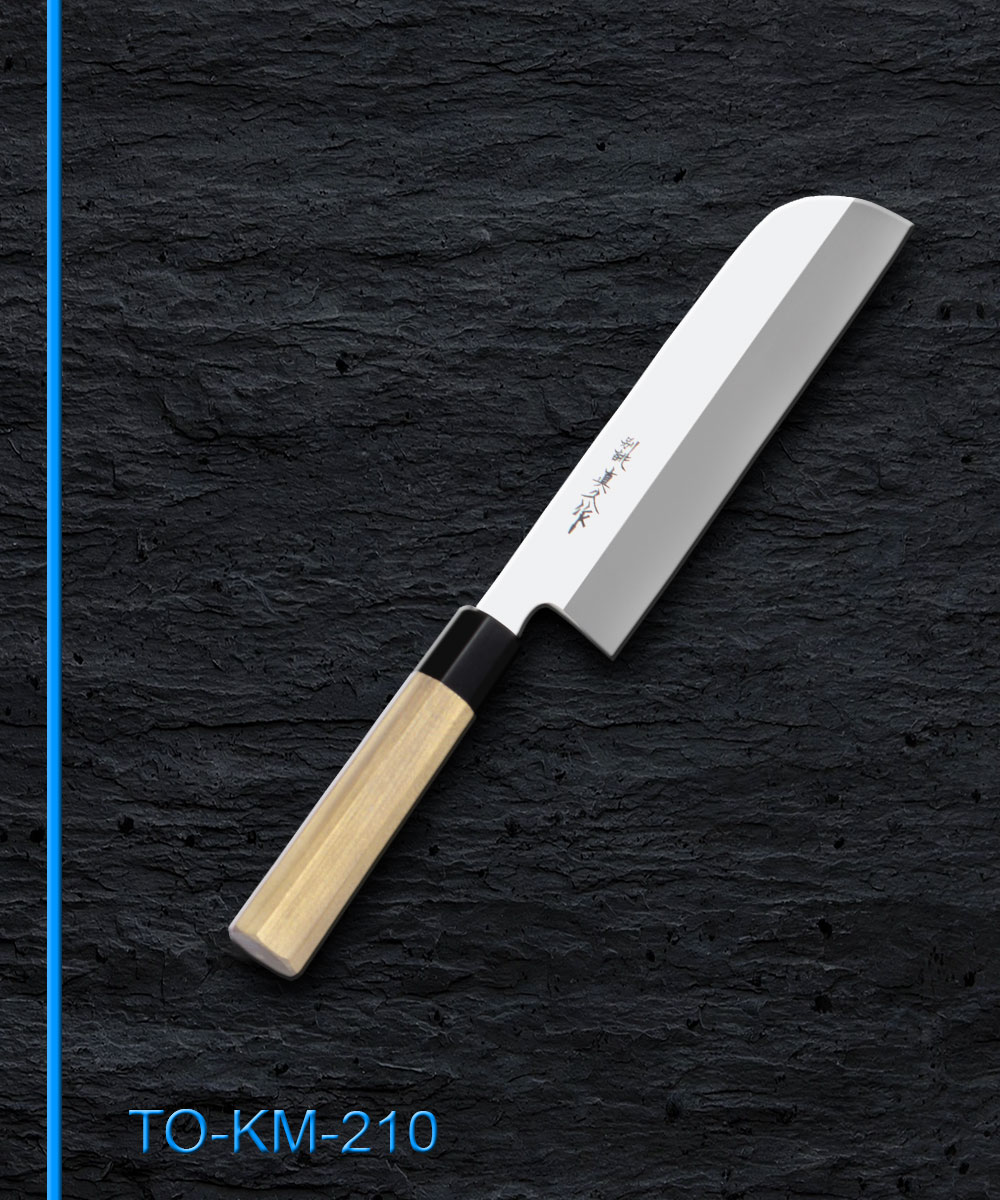
The TO-KM-210 from the prestigious TO Honoyaki series is not an ordinary vegetable knife. It is a tool created for those who treat the kitchen as an art form, where every slice is a deliberate, refined gesture. In this Honoyaki interpretation, the Kamagata Usuba (鎌形薄葉) embodies the essence of Japanese perfectionism: absolute precision, silent cutting, and total control over the ingredient.
This traditional Japanese knife for vegetables and fruits served raw is designed to preserve natural color, structure, and flavor. The ultra-thin, razor-sharp Honoyaki blade minimizes cellular damage, limits oxidation, and delivers an almost perfectly smooth cut surface—exactly what top-tier Japanese cuisine demands.
The distinctive sickle-shaped Kamagata tip is a hallmark of the Kansai (Osaka) school. Unlike the classic square-tipped Usuba from the Kanto region, the curved tip offers greater versatility and fluidity of motion. This is why Kamagata Usuba is the preferred choice of masters specializing in Kazari-giri—decorative vegetable cutting where technique, aesthetics, and rhythm are equally important.
The tall, elongated blade of the TO-KM-210 handles large ingredients such as cabbage or daikon with ease, allowing long, uninterrupted strokes. Its geometry also supports guiding the blade with the knuckles of the free hand, ensuring perfectly consistent slice thickness—an essential detail in refined Japanese cooking.
The TO Honoyaki series represents the pinnacle of Japanese knife-making. Each TO-KM-210 is crafted through a demanding process that requires years of experience, precise temperature control, and complete focus from the master smith. These knives are made individually—without compromise, without automation, without mass production. That is why Honoyaki knives are sought after by professional chefs, sushi masters, and collectors worldwide.
The TO-KM-210 Kamagata Usuba is for those who understand that true luxury in the kitchen is not about quantity, but about class.
This is a knife that does more than cut—it defines the way you work.
If you would like to learn more about Japanese kitchen knives and how to choose the right ones for your kitchen or restaurant, visit our knife selection guide.





Boyce –
I dreamed of a real Japanese knife, so I chose this model and I am very pleased with it.