Additional information
| Type of knife | |
|---|---|
| Total length (mm) | |
| Knife weight (g) | |
| Blade edge | |
| Steel type | |
| Rockwell hardness of steel | |
| Stain-resistant | |
| Handle |
* does not apply to cash on delivery shipments
380.00 zł brutto
In stock
| Type of knife | |
|---|---|
| Total length (mm) | |
| Knife weight (g) | |
| Blade edge | |
| Steel type | |
| Rockwell hardness of steel | |
| Stain-resistant | |
| Handle |
You must be logged in to post a review.
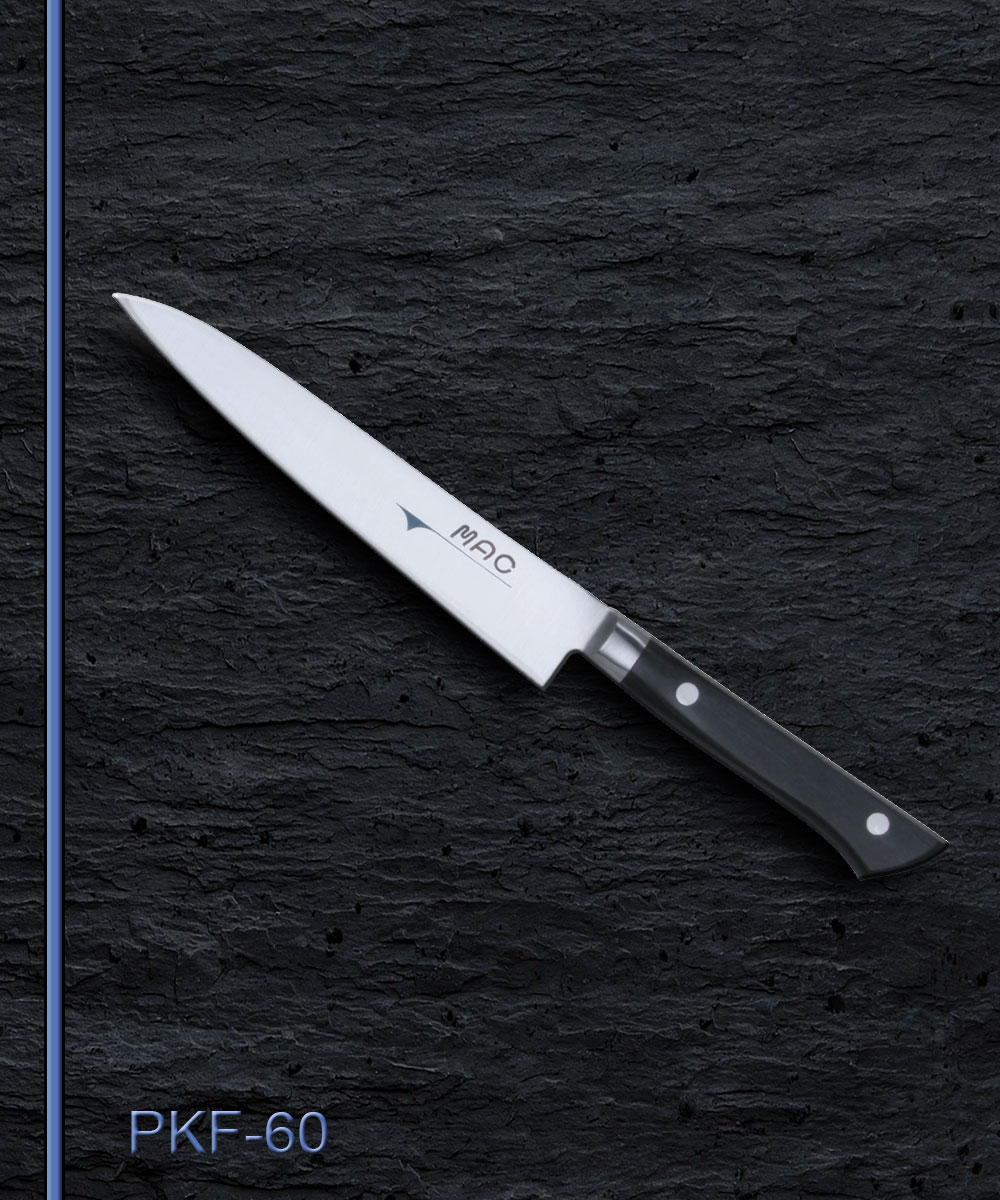
The PKF-60 from the renowned PROFESSIONAL series represents the essence of Japanese precision, reliability and refined finishing that have long defined the identity of MAC knives in professional gastronomy. This flagship line was created for chefs who demand tools with exceptional work culture, impeccable build quality and complete control over every detail of food preparation. The PKF-60 is a specialized paring knife designed with remarkable attention to ergonomics, accuracy and long-term durability.
The slender 155 mm blade, crafted from MAC Steel (AUS8) in a solid construction with a hardness of 59 HRC, delivers outstanding sharpness, ease of sharpening and consistent performance even under intensive use. The thin, finely honed blade allows for highly precise peeling, delicate slicing and controlled coring of fruits and vegetables with a level of finesse and efficiency expected in professional kitchens.
The perfectly balanced construction, with a total length of 260 mm, ensures intuitive handling and smooth control, providing all-day comfort without unnecessary strain on the hand. It is a tool that naturally follows the user’s movements, enhancing precision, workflow and the overall quality of ingredient preparation. Its compact profile combined with refined ergonomics makes it an indispensable instrument in any well-equipped professional kitchen.
The PKF-60 stands out for its excellent maneuverability and ease of use, making it ideal for professional chefs, restaurant teams and demanding culinary enthusiasts alike. It is a precision-focused tool that significantly streamlines ingredient preparation, especially in tasks where accuracy and consistency are essential.
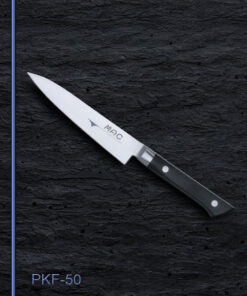
Within the same respected series, smaller counterparts — the PKF-50 and PKF-30 — are also available, maintaining the same philosophy of superior craftsmanship, perfect balance and Japanese precision. Knives of this type are fundamental to a properly equipped kitchen, and choosing a model from the PROFESSIONAL series is a conscious investment in durability, reliability and enduring performance.
An additional advantage is the enhanced stain resistance of the steel, which, with proper care, helps preserve the blade’s pristine appearance without discoloration, even when working with acidic ingredients, maintaining its refined and professional character over many years of use.
Takoyaki is one of Japan’s most iconic street foods, originating in Osaka in the 1930s. The snack was created by street vendor Tomekichi Endō, who was inspired by an earlier dish called akashiyaki from the Hyōgo region. Unlike the softer and more delicate akashiyaki, takoyaki evolved into crispy, round balls filled with pieces of octopus, cooked in a special molded pan with half-spherical indentations. Over time, it became a symbol of matsuri festivals, yatai food stalls, and Osaka’s vibrant street food culture, representing joyful, communal eating and the simple pleasure of freshly made hot snacks.
200 g all-purpose flour
2 eggs
600 ml dashi broth
1 tsp soy sauce
1/2 tsp salt
200 g cooked octopus (cut into small pieces)
2 green onions (finely chopped)
50 g pickled ginger (beni shoga, optional)
oil for cooking
takoyaki sauce (or okonomiyaki sauce)
Japanese mayonnaise
katsuobushi (bonito flakes)
aonori (dried seaweed flakes)
In a bowl, mix the flour, eggs, dashi, soy sauce, and salt until you obtain a smooth, fairly thin batter.
Heat a takoyaki pan and generously oil each cavity.
Pour the batter into the molds, filling them almost to the top.
Add a piece of octopus, chopped green onions, and a bit of pickled ginger into each portion.
Once the edges begin to set (after about 1–2 minutes), use skewers to turn the balls 90°, then gradually rotate them to form full spheres.
Cook while turning for about 4–5 minutes until golden and crispy on the outside and soft inside.
Remove the finished takoyaki and drizzle with takoyaki sauce and Japanese mayonnaise.
Sprinkle with bonito flakes and aonori, then serve immediately while hot as a classic Japanese street food snack.

In stock

In stock

In stock

In stock

In stock

In stock

In stock

In stock

In stock
Zdjęcia ilustrujące przepisy na stronach produktowych wykorzystano z serwisów: photo-ac.com, freepik.com i pixabay.com na podstawie licencji udzielanych przez owe serwisy.
Podaj swoje imię i nazwisko, numer telefonu oraz godziny w jakich możemy skontaktować się z Tobą.
Oddzwaniamy tylko pod numery telefonu z polskim numerem kierunkowym +48.
Reviews
There are no reviews yet.