


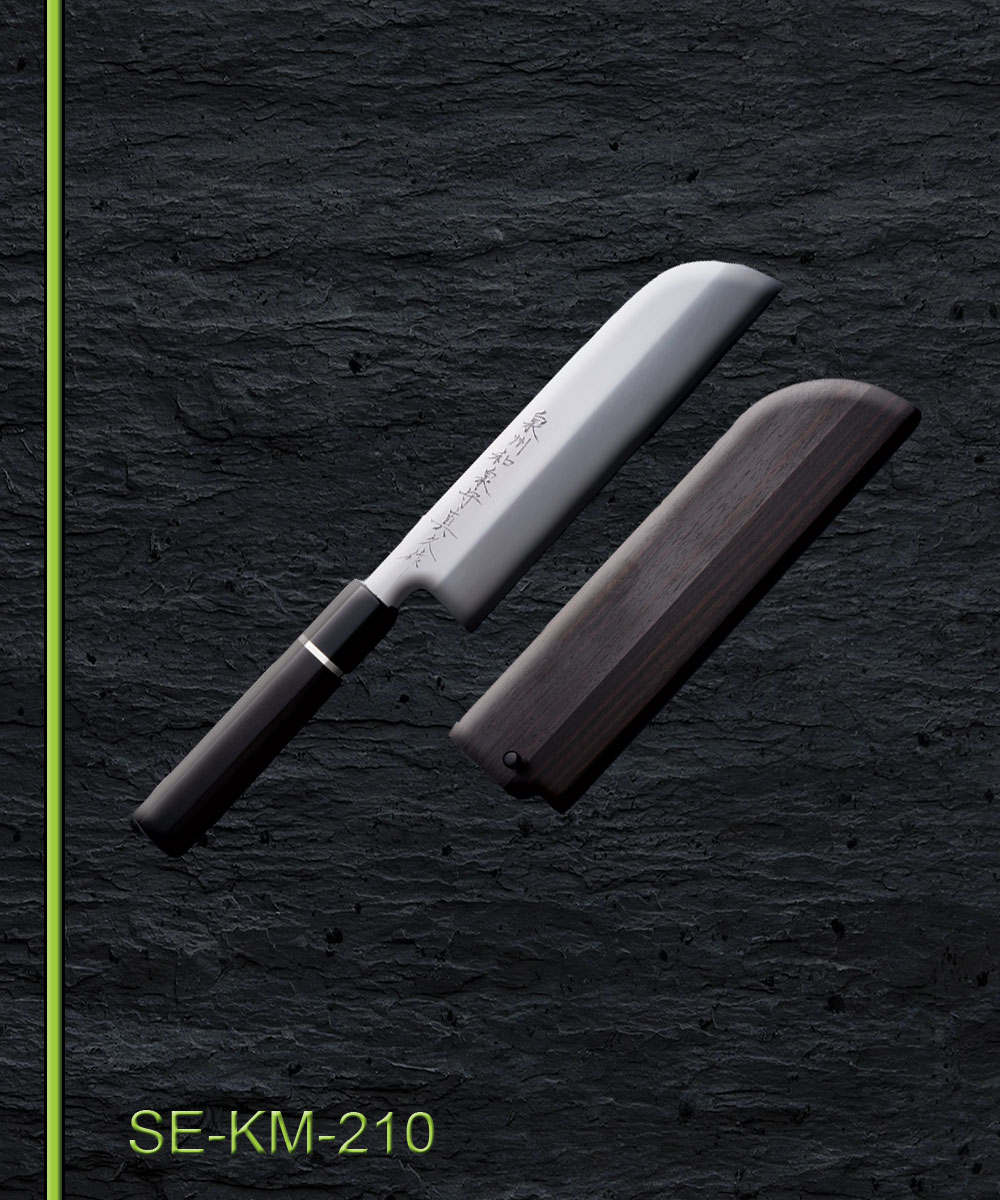


SE-KM-210 Kamagata Usuba — Finesse That Turns Vegetables into Art
The SE-KM-210 from the elite MAC SE series is a knife created for those who see cutting as more than a technique. It is a tool of aesthetics, precision, and conscious control over form. The Kamagata Usuba is the choice of masters who want not only to cut, but to shape—with surgical accuracy and complete authority.
Each piece is handcrafted in Sakai, in the Kansai region of Ōsaka, where the highest tradition of Japanese bladesmithing has evolved for centuries. The blade is forged using the prestigious Honyaki technique from solid Yasuki Shirogami (White Steel)—a legendary, exceptionally pure, and uncompromising material. This steel allows for absolute sharpness and responds perfectly to differential hardening, yet it forgives no mistakes. In the SE series, every stage must be flawless—otherwise the blade simply does not exist.
Differential hardening gives the blade its distinctive character: an extremely hard, razor-sharp cutting edge combined with controlled flexibility along the spine. The result is a refined cutting feel that allows raw vegetables and fruits to be worked without damaging their cellular structure, juices, or natural color. This is precision you can see on the plate.
The Kasumi finish is achieved through prolonged, meticulous hand polishing with water stones. It gives the blade its characteristic silky, milky, mist-like surface, subtly emphasizing the blade line and the steel’s structure. This finish is a clear signal of master-grade quality—instantly recognized by professionals and collectors alike.
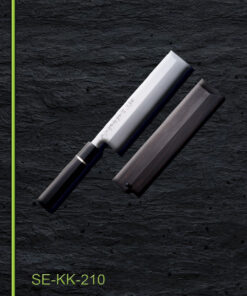
The SE-KM-210 is a Kamagata Usuba (鎌形薄葉)—a traditional Japanese vegetable knife distinguished by its characteristic sickle-shaped tip. Originating from the Kansai region, this form is more frequently chosen than the square Usuba of the Kanto region, as the curved tip offers greater versatility and control. It is a blade designed for precise, fluid, and intentional work.
The sickle-shaped tip excels in Kazari-giri, the Japanese art of decorative cutting, and in all tasks where exactness, delicate contact with the ingredient, and precise control over the beginning and end of each cut are essential. It is a tool that allows vegetables to be shaped almost like sculpture, with millimeter-level accuracy.
The tall, long blade handles large ingredients such as cabbage or daikon with ease, offering excellent stability and visibility along the cutting line. The high blade profile works perfectly with knuckle-guided cutting, enabling perfectly consistent slice thickness. This knife is designed for precision—not force—and is therefore not intended for very hard vegetables or fruits that could damage the delicate edge.
The SE-KM-210 is not an everyday utility knife.
It is a tool of form and aesthetics—for those who understand that true luxury in the kitchen begins where every cut becomes almost invisible, and the ingredient retains its natural perfection.


Reviews
There are no reviews yet.